refund visibility optimization
Macro Background
In the Latin America market, DiDi has relatively low refund awareness, which leads to a high rate of refund-related disputes. Therefore, the purpose of this requirement is to improve users’ perception of the refund process.
Current Situation
When passengers place an order and trigger SSL presale payment, prepayment, or pre-authorization strategies, users have a strong perception of payment deduction or fund freezing, but a weak perception of refund or fund release. Currently, refund guidance mainly relies on breadcrumb notifications, which results in weak user awareness.
User Pain Points
When a payment fails, users do not know the reason for the failure or how to resolve it.
Users cannot view the refund status and do not know whether the refund has been completed successfully.
Refund processing takes too long, and the time for the money to return is much later than users expect.
Competitive Analysis
Taking the Mexico market as an example, in the payment experience evaluation, DiDi scores lower than Uber in both payment and refund dimensions, mainly reflected in two aspects:
1. Insufficient explanation of payment failures, with a score gap of about 0.8 points.
2. Slow refund processing speed, with a gap of about 1 point, which is also the largest difference.
This conclusion is based on the UX Benchmark Analysis.
Design Goals
When users cancel an order, use a strong pop-up notification to clearly inform users that the prepayment has been refunded and the pre-authorization has been released.
Reduce TPO (refund-related complaints) caused by prepayments and pre-authorizations, and narrow the experience gap with competitors.
Design Solution
Cancel Trip on the Waiting Response Page
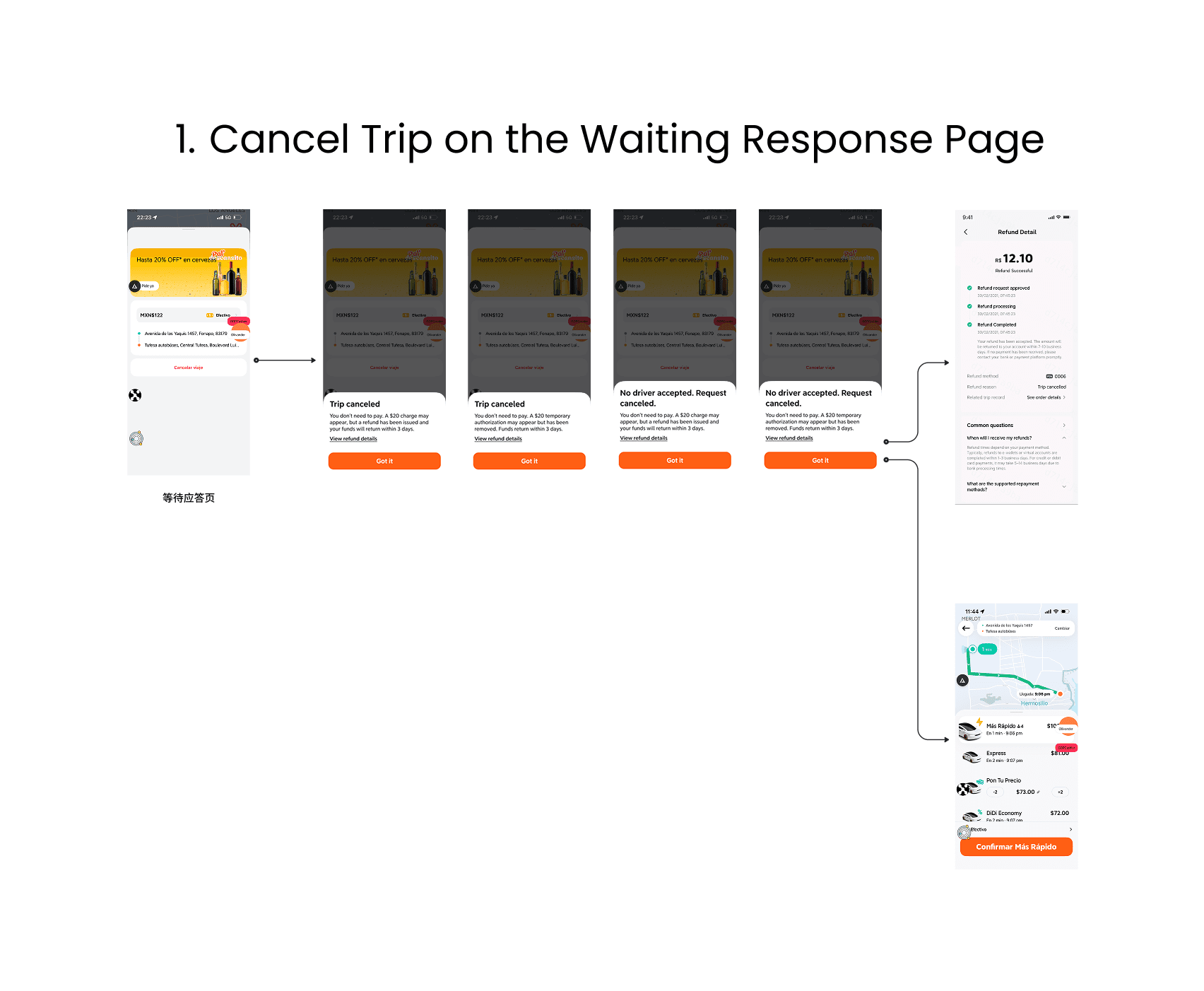
When users trigger the anti-fraud strategy and initiate a refund, and then click Cancel Trip on the waiting response page:
1. A new pop-up notification is added to replace the original breadcrumb prompt.
2. The pop-up clearly informs passengers that the trip has been canceled, and provides a link to the refund details page.
3. Clicking “Got it” will lead to a refund notification bubble page.
According to the strategy rules, refund scenarios are divided into pre-authorization and prepayment, and combined with active cancellation and passive cancellation, forming four different situations.
Cancel Order on the Pickup Page
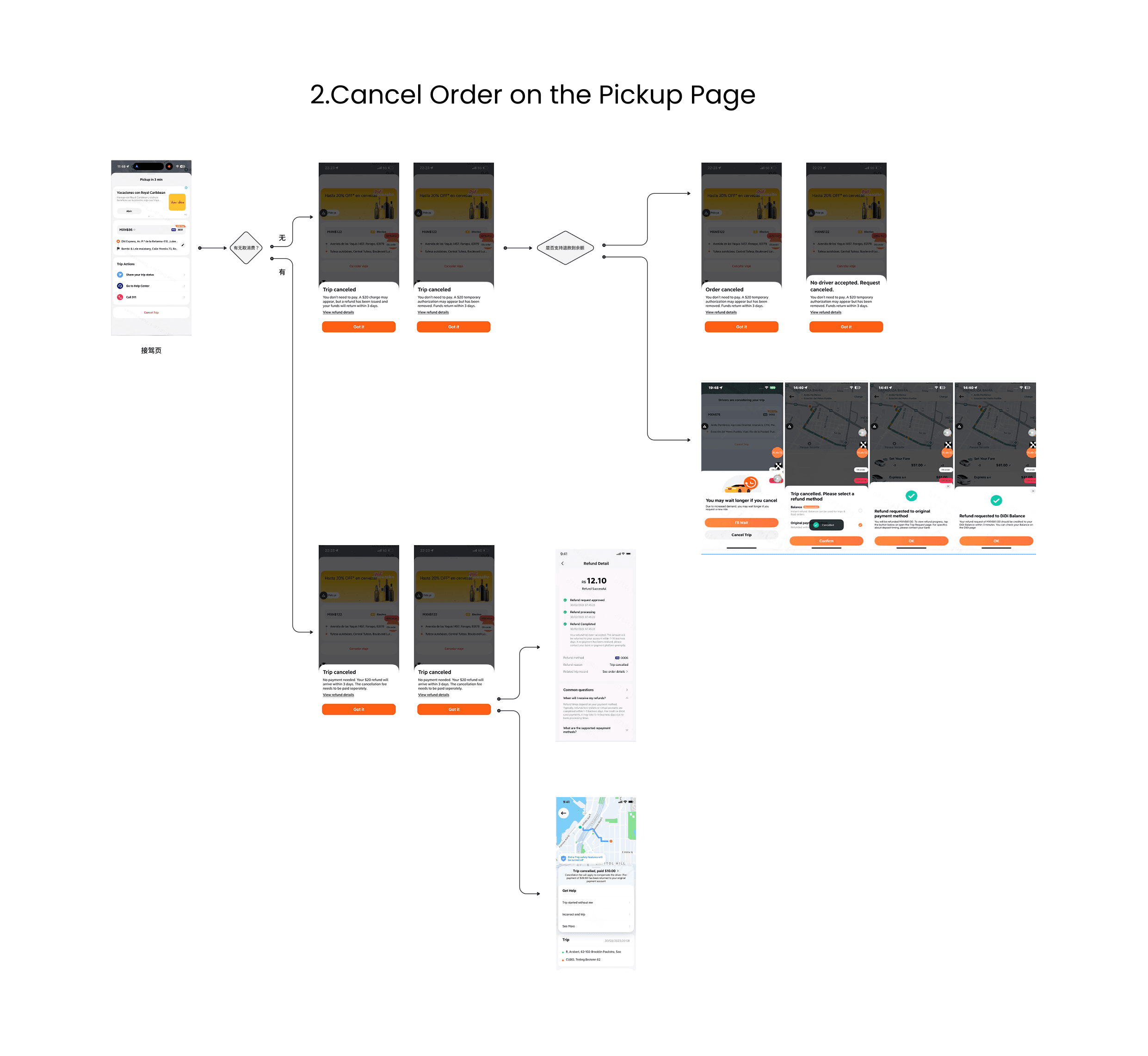
When users trigger the anti-fraud strategy and initiate a refund, and then click Cancel Order on the pickup page:
1. A new pop-up notification is also added, with an option to navigate to the refund details page.
2. Clicking “Got it” will return the user to the trip completion page.
3. According to the strategy, it is necessary to determine whether there is a cancellation fee
No cancellation fee: divided into prepayment and pre-authorization scenarios.
In the pre-authorization scenario, it is further necessary to determine whether the refund goes to the balance. If it does, the original process will be followed.
With cancellation fee: divided into prepayment with cancellation fee and pre-authorization with cancellation fee.
Copywriting Optimization Focus
The copywriting optimization mainly focuses on two aspects:
1. Whether there is a cancellation fee — in scenarios with a cancellation fee, the payment needs to be explained separately.
2. The difference between prepayment and pre-authorization: Prepayment: the money will be refunded to the user’s bank account or DiDi Card.
Pre-authorization: the funds are released (unfrozen) rather than refunded.